
In this article
In most imaging modalities, the danger is switched on and off. An X-ray tube only emits radiation when it fires. An MRI scanner is different in a way that catches new students off guard: the magnetic field never turns off. It is on when the room is empty, on overnight, on during a power outage. A ferromagnetic object brought into that room becomes a projectile instantly, with no warning and no way to stop it. This is why MRI safety is not a topic students study once and move past. It's a discipline they carry into every shift for their entire career.
Why screening is everything
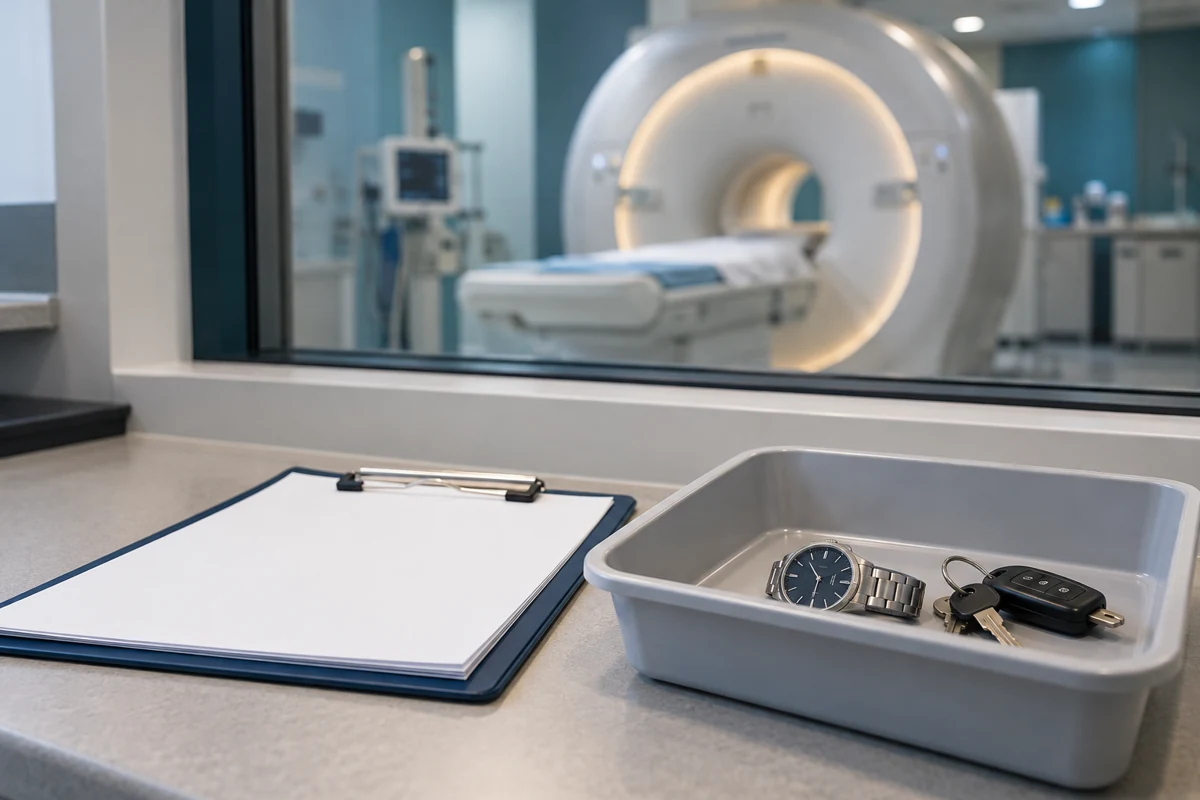
The overwhelming majority of MRI safety comes down to one thing done well: screening. Before any patient or any object enters the scan room, someone has to verify it is safe. Pacemakers, certain implants, aneurysm clips, metal fragments in the eye, some tattoos, oxygen tanks, wheelchairs, even a hairpin, any of these can turn a routine scan into a catastrophe. A technologist's job is to catch what the patient forgot to mention and what the untrained eye would miss.
The zones that structure a safe facility
Well-run MRI facilities organize physical space into safety zones, moving from freely accessible public areas to the tightly controlled scan room itself. Each boundary is a checkpoint. Students learn to understand not just where the zones are, but why each transition demands a fresh verification. Safety isn't a single gate at the door, it's a series of deliberate checks that build on each other.
Stop, verify, escalate
The single most important reflex we build into every student is simple: when a safety question cannot be resolved with certainty, stop and escalate. Never guess. A student who proceeds because they're embarrassed to ask, or because they assume it's probably fine, is the student who eventually causes an incident. The technologist who stops the line to double-check an implant is not slowing things down, they're doing the job exactly right. We train that instinct until it's automatic.
Why a documented safety gate matters
It isn't enough to teach safety. A serious training program has to prove that no student reaches a live scanner without a clean, documented safety record. Our safety gate defines the must-pass items and provably blocks any student with an unresolved deficit. This protects three parties at once: the student, who never gets put in a situation they're not ready for; the facility, which never has an unqualified person near the magnet; and the partner program, whose reputation rides on every graduate they send into the field. When evaluating a clinical site, the safety gate is one of the first things to ask about.
The mindset that lasts a career
The best MRI technologists share a trait: they never get casual about the magnet. Years into the job, they still screen with the same discipline they did as students. That mindset is built early, in clinical training, in an environment where the stakes are real and the standards don't bend. A student who learns safety as a reflex rather than a rule becomes a technologist any department is glad to hire.